Thankfully, I applied to Grad Schools LAST year.
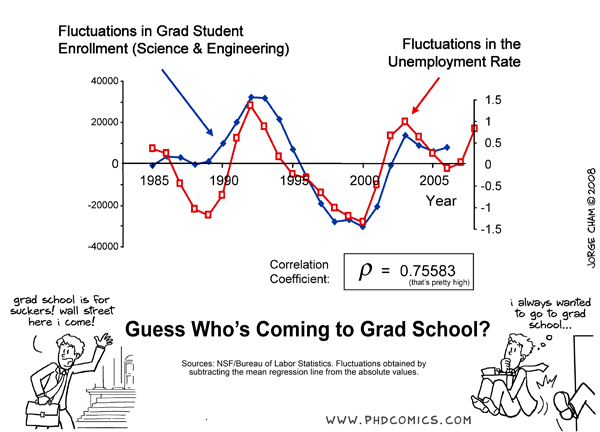
And thank god for Academia
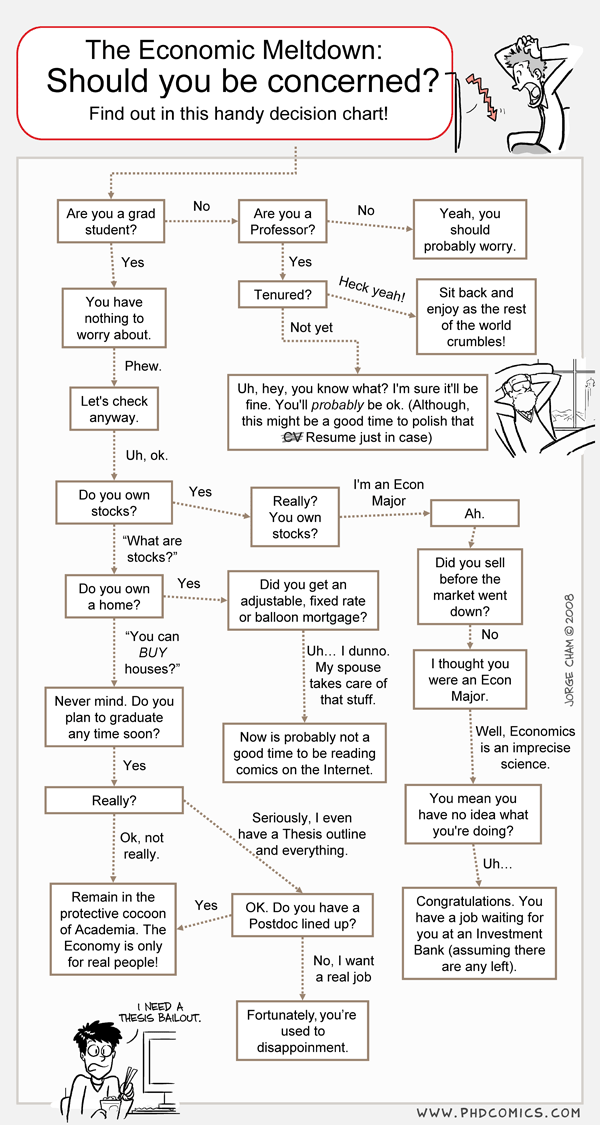
Thankfully, I applied to Grad Schools LAST year.
And thank god for Academia
Three professors — a physicist, a chemist, and a statistician — are at a department head meeting when a fire breaks out in a wastebasket.
The physicist says, “I know what to do! We must cool down the materials until their temperature is lower than their ignition temperature and then the fire will go out.”
The chemist says, “No! No! I know what to do! We must cut off the supply of oxygen so that the fire will go out due to lack of one of the reactants.”
As the physicist and the chemist debate what to do, the statistician runs around the room lighting more fires.
“What are you doing?!” the physicist and the chemist scream.
The statistician replies, “We’re going to need a larger sample size.”
Upon finishing my comprehensive exam at GW, I had to e-mail it to the department as a back up copy. Sarah Binder and I had the following GChat conversation.
Steve: Parties matter 😉
Sarah: No they don’t!
Steve: Uh oh
Sarah: Just kidding. Congrats on finishing!
For the first first time since June, I do not have anything pressing to work on for some academic purpose. I am a little befuddled of what to do with myself. 🙂
Abstract
Crook & Hibbing (1997) and others argue that the Seventeenth Amendment and the institution of the direct election of Senators have made the Senate more responsive. To make this argument, previous research compares the direct and indirect election time periods before and after the Seventeenth Amendment. Instead this work creates counterfactual, indirectly elected Senates since 1918. Swing-ratio models using the actual Senate election returns are applied to the factual and counterfactual Senates to compare their levels of responsiveness. Similar to previous research, direct elections are found to be more responsive than indirect elections nationwide. However a central finding of this work is that this increased responsiveness is largely attributable to elections in the south.

The decision was tough, but it is the one I am most comfortable with.
As many of you know, I am in the midst of selecting a PhD program. I have been pretty fortunate with my selection set. However today has been a little amusing.
I am doing some work to prepare for my GWU Comprehensive Exam in May. Basically, learn a shit load of authors, years of their articles, and get their arguments into 2 sentences.
It is quite surreal to be making a notecard about a Political Scientist, and then have that very political scientist pop up in your Outlook e-mailing you. This has happened twice today.
Back to notecards.